


The Peppol Network - Explained


Quick Guide to Understanding the Peppol Network
Understand the Peppol network in 5 minutes
You’d think that in a world where nearly everything is digital, e-ordering and e-invoicing would already be standard practice. But surprisingly, it’s not. Even in highly digital economies, adoption is patchy. Many businesses still send orders and invoices as PDFs over email or worse, as paper copies by post.
As global trade grows, this manual approach just doesn’t make sense anymore. It slows down supply chains, payments, creates errors, and adds unnecessary admin without creating business value.
That’s where Peppol comes in. It’s a framework designed to make the exchange of electronic business documents seamless, both domestically and internationally. By setting common standards for document transport and document formats, Peppol ensures technical and business process interoperability across borders for public and private organizations alike.
What is the Peppol network used for?
The Peppol Network serves as a secure, standardized infrastructure to exchange a variety of electronic business documents. While e-invoicing remains the predominant use case today, the network is capable of handling orders, credit notes, catalogues, dispatch advice and more, essentially digitizing end-to-end business process flows.
Peppol started as a so called large scale project funded by the European Commission beginning in 2008 to enable cross-border public procurement. Initially, public bodies were the first adopters and Sören Pedersen, one of the founders of Arratech were part of setting up the first Access Point in Sweden.
Over time, however, B2B adoption has taken off, especially in places like Norway, where policy and incentives encouraged broad uptake. Its appeal lies in the cost and friction savings: once connected, businesses (B2G or B2B) can exchange documents reliably and securely without building custom integrations for every counterparty.
As of October 2025, approximately 2 million receiving organizations are registered on Peppol in about 98 countries around the globe.
The network operates via certified Peppol Access Points that connect those organizations into the Peppol Network.
These numbers reflect significant growth over a short time showing how rapidly Peppol has expanded beyond its European roots to become the fastest growing global network for business document exchange.
The Peppol Four-Corner Model
At the heart of the Peppol network is the Four-Corner Model, a structure that allows any participant to securely exchange documents with any other, regardless of their service provider.
Each organization connects to the network through its chosen Access Point (AP). When one participant sends an e-invoice or order, their AP communicates directly with the recipient’s AP, ensuring interoperability, compliance, and end-to-end security.
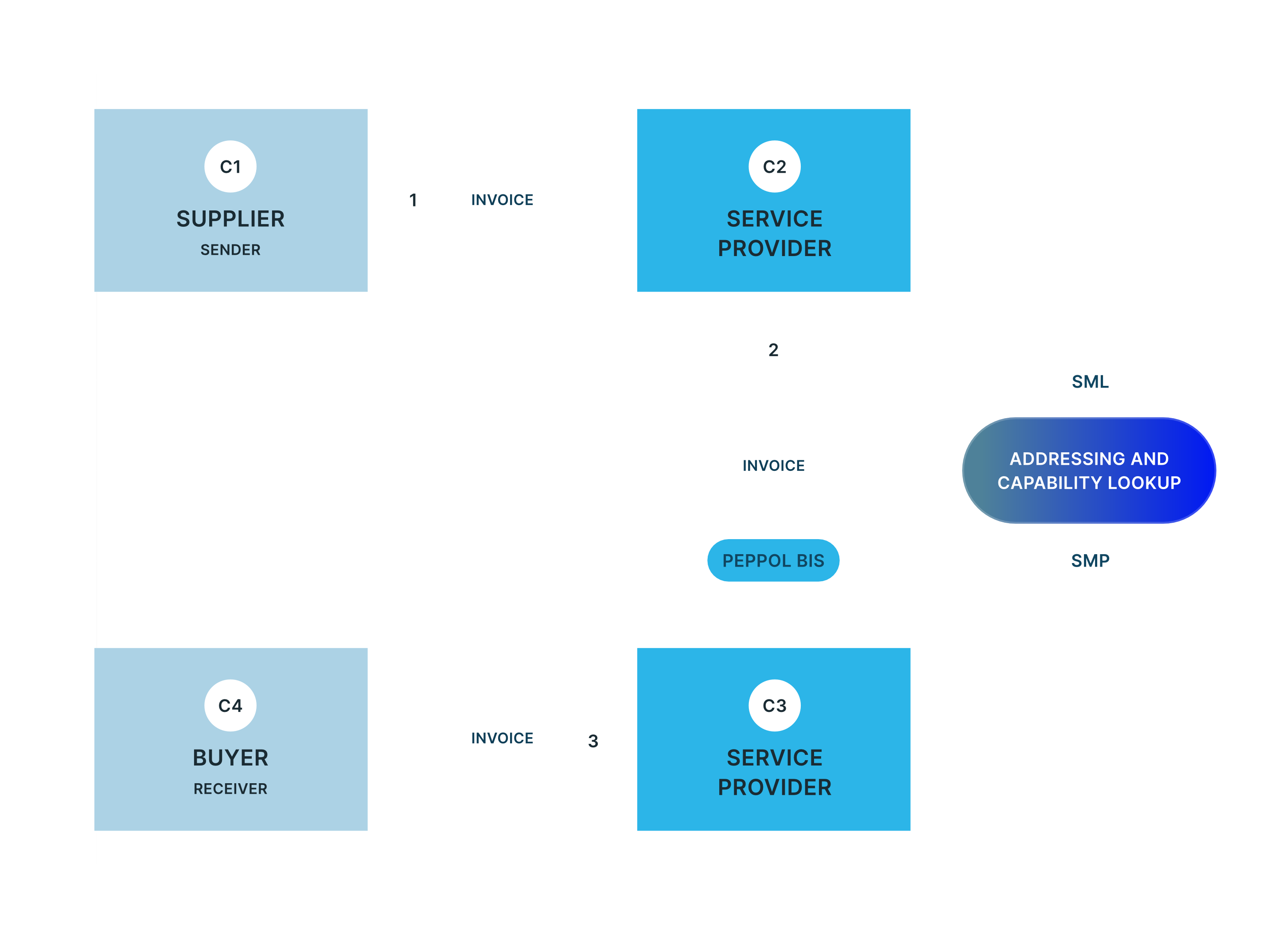
C1 - Corner 1 – Sender: The organization initiating the transaction, such as issuing an e-invoice or purchase order.
C2 - Corner 2 – Sender’s Access Point: Sends the document into the Peppol Network, ensuring it’s validated and transmitted securely.
C3 - Corner 3 – Receiver’s Access Point : Receives the document from the network and delivers it to the correct recipient, following Peppol standards.
C4 - Corner 4 – Receiver: The final recipient of the document, such as a buyer, customer, or public authority.
What is a Peppol Access Point?
A Peppol Access Point (AP) is a certified piece of software, operated by a Service Provider, that allows organizations to send and receive electronic business documents, such as e-invoices, orders, and shipping notices, using a standardized syntax and a secure transport mechanism under a legal framework. Access Points operate within what is called the four-corner model, where senders and receivers communicate only through their respective Access Points, which then transmit the documents across the Peppol network. This model enables interoperability and compliance without requiring direct integration between every trading partner, significantly reducing complexity for businesses. The four-corner topology also introduces a model for unlimited scalability, very similar to how mobile phone networks are built.
Each Access Point must comply with strict technical specifications and governance rules outlined by OpenPeppol, including the use of structured document formats (such as UBL or EDIFACT) and a secure transport protocol like AS4 for AP-to-AP document exchange. These rules ensure a high level of security, interoperability and scalability for domestic and cross border exchange.
Think of a Peppol Access Point as your business’ passport control—clearing eInvoices and orders safely across digital borders.
For example, the European Commission endorses the Peppol framework as part of its efforts to standardize eProcurement across EU member states, making Access Points an essential part of achieving e-invoicing compliance under the EU directive 2014/55/EU.
Rather than setting up and managing their own infrastructure, many businesses choose to use certified Peppol Access Point providers, which are already certified and connected to the network. This approach allows faster onboarding, reduced operational risk, and instant compliance with local and international requirements. In this context, Peppol Access Points are not just data pipelines, they are critical enablers of digital transformation in procurement and tax reporting across both public and private sectors.
Document validation & routing in Peppol networks
Document validation and routing are essential processes that ensure the safe and compliant exchange of electronic documents between organizations. When a sender submits a document, such as an invoice or purchase order, to their Service Provider's Access Point, the message undergoes a validation process to ensure it meets the technical and semantic rules defined by the Peppol BIS (Business Interoperability Specifications) and supported syntaxes like UBL (Universal Business Language).
In Peppol, every document is checked before it travels, because trust in the network starts with validation at the source.
Validation checks include verifying the structure of the XML document, adherence to schemas, presence of required elements, and business rules relevant to the transaction type. This step is critical because it prevents the propagation of incorrect or non-compliant documents, which could otherwise lead to errors, rejections, or regulatory issues.
After successful validation, the document is routed through the Peppol Network with the help from the Service Metadata Publisher (SMP) and the Service Metadata Locator (SML). The SMP provides metadata about recipients, including their capabilities to accept specific document types. The Access Point uses this metadata to determine the recipient's Access Point and securely deliver the message. The entire process is specified by the Peppol transport protocol, which defines how messages are exchanged using the AS4 protocol, ensuring encryption, non-repudiation, and reliable delivery.
This validation and routing mechanism allows Peppol to function as a decentralized but trusted network for eProcurement and e-invoicing. It eliminates the need for bilateral agreements between each sender and receiver and replaces them with a shared infrastructure based on standards and automation. As a result, organizations can reduce processing errors, ensure legal compliance across jurisdictions, and increase operational efficiency when participating in electronic document exchange through the Peppol network.
SMPs, making you discoverable
Within the Peppol network, the Service Metadata Publisher (SMP) and Service Metadata Locator (SML) are foundational components that enable dynamic document routing and ensure that electronic messages reach the correct recipient in a secure and standardized manner. The SMP is a decentralized directory that contains information about each recipient's capabilities, such as which types of documents it can receive, the transport protocols it supports, and which Access Point it uses to receive documents.
If the Peppol Network was a postal system, the SML would be the directory that shows where your SMP can be found, and the SMP would list your pick-up locations for each received document type.
Each organization registered as a receiver in Peppol has an SMP entry that acts like an address book, providing essential metadata required for proper delivery. This metadata includes the participant's identifier on the network, supported document types, and endpoint URLs. The official specifications and examples can be found on the Peppol e-Delivery documentation portal.
To locate the appropriate SMP entry for a recipient, the network relies on the Service Metadata Locator (SML), a centralized service that maps participant identifiers to the URLs of their respective SMPs. The SML uses the Domain Name System (DNS) to generate a unique domain for each participant, enabling secure and automated discovery of their metadata. When a sender initiates a document exchange, their Corner 2 Access Point queries the SML to find the correct SMP, retrieves the metadata, and uses that information to route the message accordingly.
This combination of distributed metadata (via SMP) and centralized lookup (via SML) allows the Peppol network to scale globally while maintaining interoperability and reliability. It removes the need for manual configuration or static address books, making it possible to dynamically onboard new recipients and adapt to changing document handling capabilities in real time. These components are central to the OpenPeppol vision of an open, vendor-neutral, and cross-border eDelivery infrastructure.
Seamless connection to Peppol networks
With Arratech’s Access Point Suite and SMP Suite, you can enable your software or service to start exchanging documents on the Peppol Network in no time. Enjoy instant onboarding in our portal Arratech Connect, full compliance, and seamless integration, whether you need a shared or white-labeled Peppol Access Point. Get started the easy way with Arratech and make Peppol connectivity fast, flexible, and future-ready. Contact Arratech today to learn how we enable future-proof, secure and scalable Peppol e-Invoicing.

Ready for a simple connection to the future of e-Invoicing?
Join the next generation of e-Invoicing infrastructure from Arratech.
Cut costs, stay compliant, and integrate effortlessly.
More Stories

One month into France’s e-invoicing mandate, we share eight lessons from real-world implementation, including taxpayer onboarding, PA switching, invoice formats and interoperability. Discover what we’ve learned from operating in production and why the biggest challenges go beyond invoice exchange.

Already chosen a Plateforme Agréée in France? Use these ten checks to assess production readiness, identify structural gaps and determine whether to improve your current setup or consider changing PA.

OpenPeppol is making ISO/IEC 27001 certification mandatory for all Peppol Service Providers. Learn why the requirement has been introduced, who it affects, what ISO 27001 readiness really means, and the practical steps providers should take to prepare before the implementation deadline.