


The difference between the Peppol network and traditional e-invoicing networks


In this post we provide a breakdown of how e-invoicing works in two fundamentally different environments, the Peppol network and traditional e-invoice networks, known to many as VAN-networks (Value Added Network). The goal is to clarify how each model operates from a structural, technical and regulatory perspective. Peppol’s open and standardised infrastructure is compared to the closed frameworks of legacy VAN-networks, and we discuss the practical implications for businesses and public sector organisations.
The Peppol network.
The Peppol network is an international network with a decentralised approach that allows organisations to exchange e-invoices through intermediaries known as certified service providers. Certification is handled by local government agencies, known as Peppol Authorities, with support from the central non-profit organisation OpenPeppol. No agreements or technical onboarding are needed between senders and receivers of messages or between their respective service providers. The sender and the receiver only need agreements with a service provider of their choice. This so-called 4-corner model avoids lengthy onboarding every time an organisation needs to expand its reach.
A useful analogy is mobile communication (see figure below). You can call and receive calls from your friends even if they use a different mobile carrier. This works because carriers agree on common standards that ensure interoperability, enabling many-to-many communication. On top of this, the Peppol Network also makes it easy to find the business you want to reach by using a unique Peppol ID, similar to looking up a phone number when connecting with a new friend. In both mobile communication and e-invoicing, this model provides flexibility and avoids vendor lock-in while guaranteeing security and trust. Read more in our post The Peppol Network – Explained.
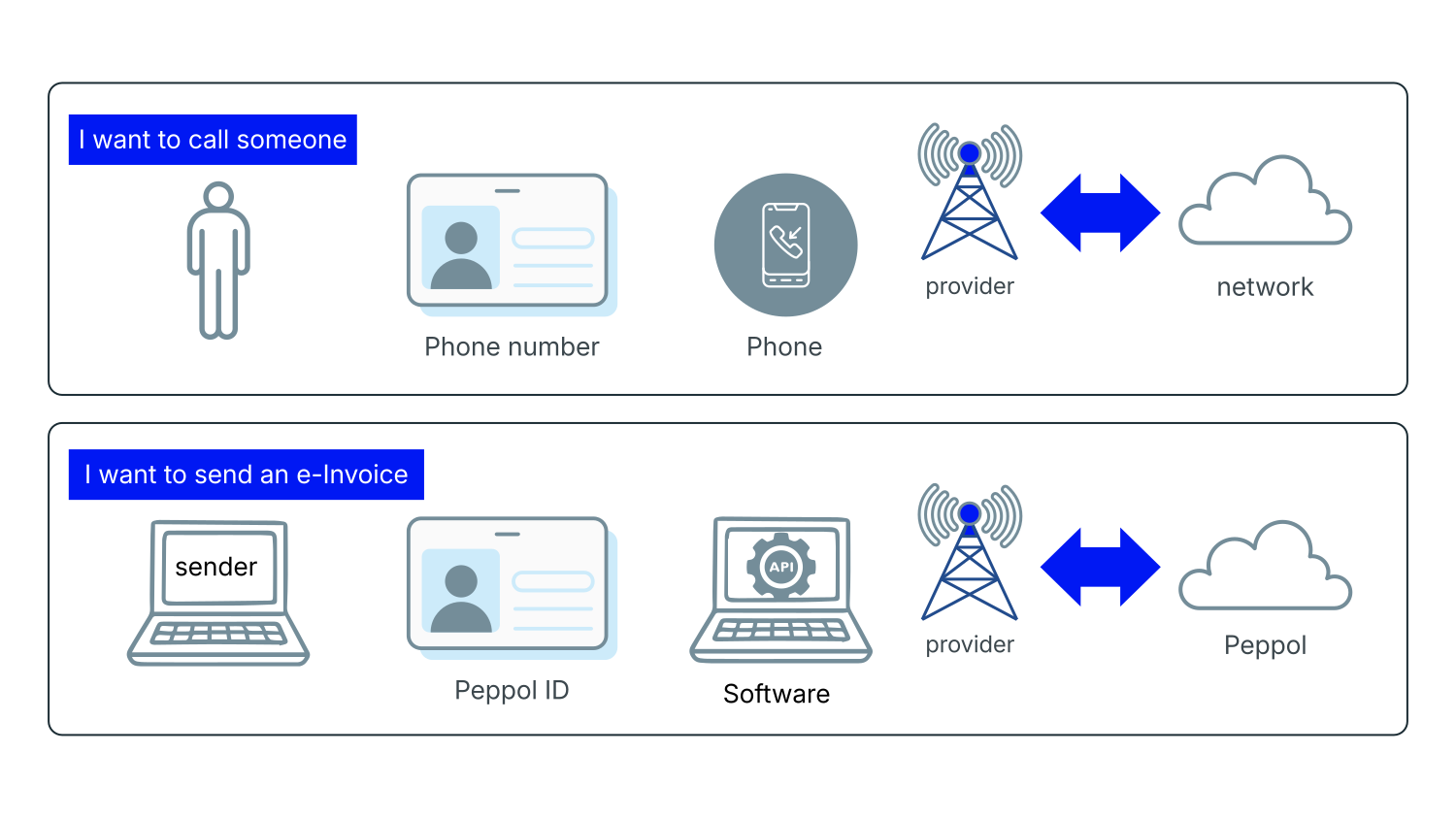
The Peppol network are based on several key components, including the interoperability framework, common message standards, and OpenPeppol itself, which develops the standards and fosters coherence between the involved actors. All technical specifications and supporting information are available free of charge. Companies that want to provide services based on the Peppol documentation may become members of OpenPeppol by paying an annual membership fee, and can then apply to become certified service providers.
No agreements or technical onboarding are needed between senders and receivers.
Furthermore, a service provider can only charge its own customer and never other service providers, for example through roaming fees. This ensures that dominant commercial incentive structures do not become a hindrance to achieving optimal message design and an efficient transport architecture.
Controls and validations are built into the network, which means that e-invoices delivered are correct and comply with the European standard EN16931, making the network ready for the wave of upcoming national e-invoicing mandates based on the European norm. Furthermore, the infrastructure is document-type agnostic and supports a wide range of business processes beyond e-invoicing, such as catalogues, orders, and despatch advices. With a 5-corner CTC reporting model currently under development within OpenPeppol, the network also positions itself to support the reporting requirements that will accompany ViDA (VAT in the Digital Age). Read more about 5-corner CTC reporting under our solution page for tax authorities.
Controls and validations are built into the Peppol network
Traditional e-invoice networks
Traditional e-invoice networks have for decades been the dominant infrastructure for the exchange of e-invoices and other business documents. These networks, often referred to as VAN networks, rely on bilateral agreements between operators. This creates a fragmented ecosystem where customers, in terms of their reach, are at the mercy of their operator’s network of partnerships.
Onboarding typically involves proprietary formats, custom mappings and operator-specific testing, which increase costs and slow adoption. Not only is the initial onboarding process costly and time-consuming, ongoing operations are also error-prone due to frequent format conversions. These errors lead to repeated stops and restarts in message handling, requiring manual intervention, which counteracts one of the core goals of electronic document exchange, automation.
Traditional networks creates a fragmented ecosystem where customers are at the mercy of their operator’s network of partnerships.
VAN-networks have also created incentive structures that give certain operators a gatekeeping role, build barriers to innovation, and maintain higher costs for end users. This rigidity has contributed to many old e-invoice formats still persisting. Many of these formats do not comply with the European standard EN16931 and will therefore not be usable to meet many of the coming national e-invoicing mandates or the requirements of ViDA. Compared to Peppol’s open, many-to-many model, VAN networks are more expensive to maintain and less future-proof.
Join Arratech on the right side of history
If you have not figured it out yet, Arratech favours the Peppol network, and others like it that share the same characteristics of openness, interoperability and innovation. To connect your customers to the leading e-Invoicing network with a promise of global reach and built-in compliance with many upcoming legal initiatives in Europe and beyond, contact us to learn how we can support you.
More Stories

One month into France’s e-invoicing mandate, we share eight lessons from real-world implementation, including taxpayer onboarding, PA switching, invoice formats and interoperability. Discover what we’ve learned from operating in production and why the biggest challenges go beyond invoice exchange.

Already chosen a Plateforme Agréée in France? Use these ten checks to assess production readiness, identify structural gaps and determine whether to improve your current setup or consider changing PA.

OpenPeppol is making ISO/IEC 27001 certification mandatory for all Peppol Service Providers. Learn why the requirement has been introduced, who it affects, what ISO 27001 readiness really means, and the practical steps providers should take to prepare before the implementation deadline.

Ready for a simple connection to the future of e-Invoicing?
Join the next generation of e-Invoicing infrastructure from Arratech.
Cut costs, stay compliant, and integrate effortlessly.